
Your Guide to a Proactive Tree Pruning Schedule
One of the most common questions we receive from homeowners is, “How often do my trees need to be pruned?” It’s a great question, because it shifts the mindset from reactive (calling when there’s a problem) to proactive (maintaining health). The answer, however, isn’t a simple one-size-fits-all number. The ideal pruning frequency depends on the tree’s species, age, health, and your specific goals for your landscape.
Here’s a general guide to help you build a smart, proactive tree maintenance schedule.
The General Rule of Thumb: The 3- to 5-Year Cycle
For most mature hardwood trees, such as oaks, maples, and elms, a professional structural pruning is recommended every 3 to 5 years. This cycle is typically sufficient to:
- Remove any dead or dying branches.
- Correct structural issues that may have developed.
- Maintain clearance and shape.
- Allow an arborist to spot any potential health issues before they become major problems.
This doesn’t mean you should ignore your trees for 3 years. An annual visual inspection from the ground is always a good idea, especially after a storm.
Young Trees: More Frequent, Lighter Pruning
Young trees benefit from more frequent attention. A light structural pruning every 1 to 2 years for the first decade after planting is crucial. This is called “subordination pruning” and it helps the tree develop a strong central leader and a sturdy branching structure. Investing in proper pruning during a tree’s formative years is the single best way to prevent major, expensive problems later in its life.
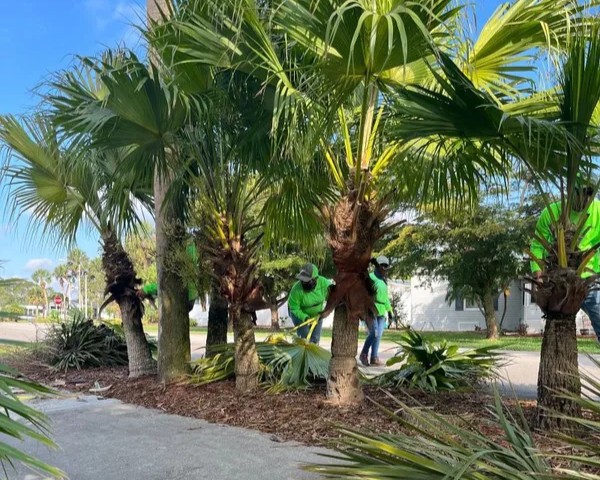
Palm Trees: A Different Schedule
Palms are not trees, they are monocots, and their pruning needs are different. You should only prune palms when the fronds are completely brown and dead. Green or yellowing fronds are still providing nutrients to the palm. Pruning them prematurely can stress the palm and create nutrient deficiencies.
- Rule for Palms: Only remove brown, dead fronds. For most species, this means a professional pruning once or twice a year is plenty.
- Warning: Never “hurricane cut” or “pineapple cut” a palm, where all but a few fronds are removed. This severely weakens the palm and makes it more susceptible to failure in a storm.
Fruit Trees: Annual Pruning for Better Harvests
Fruit trees, such as mango, citrus, and avocado, require annual pruning to maximize fruit production and quality. Pruning is typically done in the winter or early spring to:
- Improve light penetration and air circulation within the canopy.
- Remove unproductive wood.
- Control the size and shape for easier harvesting.
When to Call Sooner: The Exception to the Rules
Regardless of the schedule, you should call a certified arborist immediately if you notice:
- A large, broken, or hanging branch.
- A sudden crack or split in the trunk.
- Signs of fungal growth (mushrooms) on the trunk or major roots.
- A sudden, unexplained change in the color or density of the leaves.
- Your tree is touching your house or power lines.
The Value of a Professional Assessment
Ultimately, the best way to know your specific pruning schedule is to have an ISA-Certified Arborist evaluate your property. As we explain in our Tree Pruning Primer, a professional can create a multi-year plan tailored to the unique needs of your landscape, ensuring each tree gets the right care at the right time.
Ready to get on a proactive maintenance schedule? Contact us for a free Tree Health Assessment and we’ll build a plan for your property.