
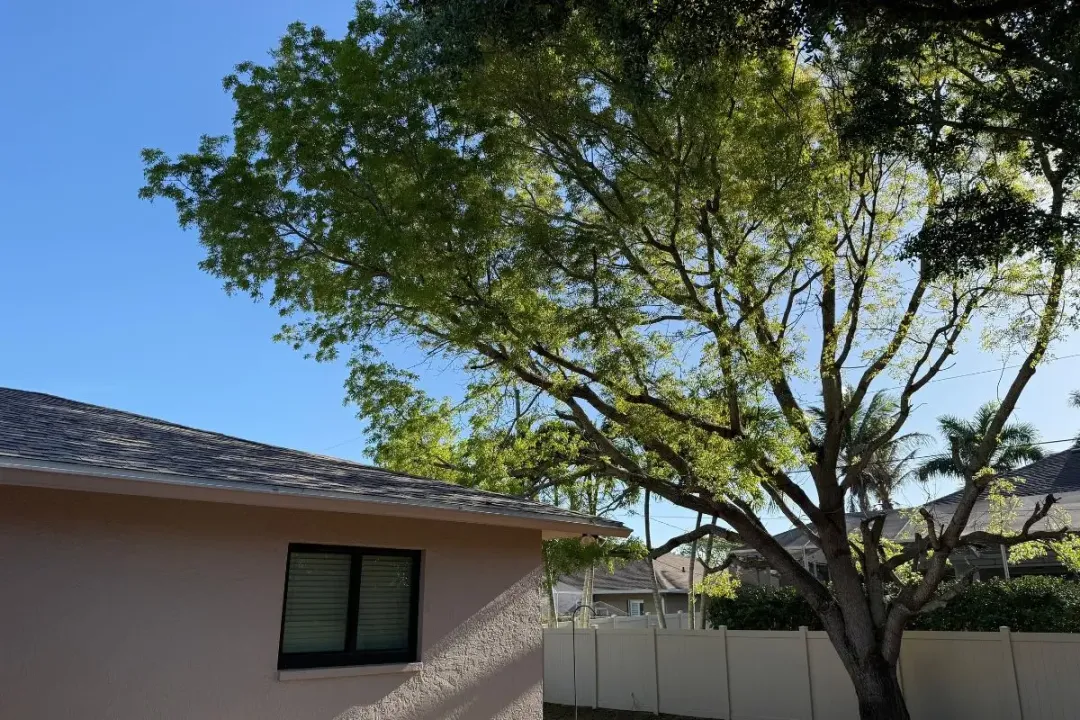
When Kyle Hamer called Joshua Tree Inc. to have several large trees pruned around his property, the immediate need seemed straightforward.
But proper tree pruning rarely begins with simply deciding which branches to cut.
During his assessment, ISA Certified Arborist and FNGLA Certified Professional Ryan Ishley identified several factors that would shape the pruning plan. Trees at the rear of the property were growing near utility lines. Portions of the mature canopy had developed greater weight toward the home. Other branches were extending toward a neighboring property, while deadwood, crossing branches, and overall canopy density also needed attention.
Ryan’s recommendation was not simply to “trim the trees.”
It was to develop a pruning prescription based on their structure, surroundings, and future growth.
The result was a more balanced canopy, improved clearance and airflow, and trees intentionally pruned to develop more appropriately within the property for years to come.

How did Joshua Tree Inc. approach the Hamer property?
ISA Certified Arborist Ryan Ishley assessed the mature trees on the Hamer property and developed a pruning prescription based on canopy structure, proximity to utility lines, growth toward the home and neighboring property, and the trees’ long-term development. Following the necessary utility clearance, Joshua Tree Inc. used selective reduction, thinning, and directional pruning to improve canopy balance, remove problematic branches, and encourage future growth in more appropriate directions.
The Story at a Glance
| The Setting | The Arborist’s Prescription | The Result |
| Several mature trees required attention near the home, utility infrastructure, and a neighboring property. | Evaluate utility conflicts first, then use selective reduction, structural and directional pruning to address canopy weight, airflow, deadwood, crossing branches, and future growth. | More balanced, intentionally maintained trees with improved clearance and a canopy better suited to its surroundings. |
1. The Assessment Changed the Approach
Kyle knew his trees needed pruning. Ryan’s job as the arborist was to determine what type of pruning they actually needed and why.
During his assessment of the rear property, Ryan identified branches growing in proximity to utility lines.
That distinction was important because pruning around energized utility infrastructure requires specialized consideration. Per UF/IFAS Extension guidance on utility line pruning, only trained line clearance professionals should work within 10 feet of an energized conductor. Where applicable, the utility provider may first perform the clearance work necessary around its lines. Once appropriate clearance is established, Joshua Tree Inc. can focus on the tree’s broader structural and aesthetic needs.
Ryan explained the difference:
“Utility pruning and arboricultural pruning serve different objectives. The utility provider’s priority is maintaining the required clearance around its infrastructure. Once that clearance is established, we can evaluate the remaining canopy and determine what pruning is appropriate for the tree’s structure, balance, and long-term development.”
That assessment allowed the team to approach the property in the proper sequence while keeping both safety and tree health at the center of the plan.
2. Years of Growth Had Created an Imbalanced Canopy
The utility lines were only one part of what Ryan identified.
As the trees matured within the space between the utilities and the residence, portions of the canopy had developed greater weight toward the home.
Rather than indiscriminately removing large limbs, Ryan prescribed selective reduction pruning to reduce some of that lateral weight while maintaining the tree’s natural structure.
The team also selectively thinned portions of the canopy and addressed deadwood and crossing branches where appropriate.
As Ryan explained:
“When we evaluate a mature tree, we’re looking at the entire canopy rather than individual branches in isolation. In this case, there was greater canopy weight developing toward the residence. Selective reduction allowed us to reduce that weight while maintaining appropriate structure. We also addressed deadwood and crossing branches and performed selective thinning where it would benefit the canopy.”
Every cut had a reason.
The goal wasn’t picking branches to remove. It was figuring out what pruning would help these trees function better in this particular environment.

3. Where You Make the Cut Matters
One of the most important differences between professional pruning and simply cutting back a tree is understanding how the tree is likely to respond after pruning.
Ryan identified several branches growing outward and downward toward the residence. Rather than shortening those limbs at arbitrary locations, the team used directional pruning to reduce them back to appropriately positioned lateral branches.
That choice helps influence the direction of future growth.
Ryan explained the arboricultural reasoning:
“The location of a pruning cut influences how that portion of the canopy develops afterward. When we’re reducing a limb that’s extending toward a structure, we can often prune back to a suitable lateral branch oriented in a more desirable direction. That allows us to reduce the branch while encouraging future growth away from the structure.”
This technique, sometimes called directional or lateral pruning, has replaced older practices like topping, a method UF/IFAS Extension notes causes decay and long-term structural weakness rather than solving clearance problems. This is especially valuable when working with mature trees such as live oaks and mahoganies.
A poorly placed cut may temporarily shorten a branch without addressing the underlying growth pattern. Proper reduction pruning considers not only what is being removed today, but also where the remaining branch structure will direct growth tomorrow.
4. Managing Mature Trees Within an Urban Environment
Trees growing around homes don’t exist in isolation.
They share limited space with roofs, utilities, driveways, neighboring properties, and other parts of the built environment. Good arboriculture accounts for all of those factors while preserving as much appropriate tree structure as possible.
That became especially relevant with a tree extending toward the neighboring property.
Rather than waiting for the canopy to become a recurring concern, Ryan recommended reducing and redirecting selected branches before they extended farther into the adjacent property.
Ryan described the strategy:
“With mature trees in a residential environment, we’re always considering how the canopy interacts with the space around it. When branches are developing toward an adjacent property, properly placed reduction cuts can provide clearance while redirecting future growth. The goal is to manage that growth proactively without making unnecessary cuts.”
That approach can help the tree coexist more successfully with the properties around it while reducing the need to repeatedly address the same growth. It’s the same forward-looking thinking that shapes our approach to storm preparation, addressing structural risk before it becomes a problem, not after.

5. Professional Pruning Is a Prescription, Not a Haircut
From the ground, two pruning jobs can look similar.
From an arboricultural perspective, they can be completely different.
Removing branches without considering tree structure, branch orientation, future growth, or the surrounding environment may change how a tree looks temporarily. Professional pruning should have a defined objective behind the cuts.
For the Hamer property, Ryan’s pruning prescription focused on:
- Reducing excessive canopy weight developing toward the residence
- Using appropriate reduction cuts rather than indiscriminately shortening limbs
- Redirecting future growth where practical
- Improving overall canopy balance
- Selectively improving airflow without unnecessarily thinning the tree
- Removing deadwood and problematic crossing branches where appropriate
- Managing growth toward the neighboring property
- Accounting for utility infrastructure before beginning the remaining pruning
The question wasn’t simply, “Which branches can we remove?”
It was, “What pruning will help these trees function better in this particular environment?”
That’s the difference an ISA Certified Arborist brings to the assessment.
And it’s The Difference That Makes a Difference.
6. Turning the Arborist’s Plan Into Professional Execution
Ryan established the pruning objectives. Then the Joshua Tree Inc. crew had to execute that prescription throughout several very large trees.
For Kyle, the professionalism of that process was just as noticeable as the finished result.
He highlighted the crew’s punctuality, communication, quality of work, and the confidence he felt in choosing Joshua Tree Inc.
Kyle shared in his review:
“Jimmy and his team showed up on time, kept me posted on every step of the way, clean cut on multiple HUGE trees! Glad I caught them on TV last year and saved their info 🤣 lol (I would’ve made a mistake and gone to someone else if not)”
That experience reflects an important part of professional tree care.
The homeowner doesn’t need to know the difference between every pruning technique before making a call. That’s the arborist’s responsibility.
Our job is to assess the trees, explain what we’re seeing in understandable terms, recommend an appropriate course of action, and make sure the work in the field reflects that recommendation.
7. The Best Pruning Decisions Keep Working After We Leave
A freshly pruned tree provides an immediate visual result.
But some of the most important benefits of proper pruning are intended to reveal themselves over time.
At the Hamer property, reduction and directional pruning weren’t selected simply to make the trees look cleaner on the day the work was completed. The pruning strategy considered how the remaining canopy was structured and where future growth would occur.
That long-term perspective is especially important for Southwest Florida properties with mature trees growing alongside homes, utilities, and neighboring properties.
Ryan summarized the philosophy behind the work:
“With mature-tree pruning, we’re thinking beyond what the tree looks like when we’re finished. We’re considering how it will respond to those cuts and how that canopy will continue developing within the property. Good pruning should address today’s objectives while preserving a sound structure for the future.”
Kyle called Joshua Tree Inc. because several huge trees needed attention.
What he received was more than a trimming service.
He received an arborist-led plan for managing mature trees within the environment around his home, and a professional crew capable of putting that plan into practice.’
Frequently Asked Questions
Why does an ISA Certified Arborist assess a tree before pruning?
A professional assessment helps determine the objectives of the pruning before cuts are made. The arborist considers factors such as species, structure, canopy distribution, dead or conflicting branches, surrounding structures, utilities, and the way the tree is likely to respond to pruning. ISA Certified Arborists are trained to make these assessments according to national pruning standards.
What is reduction pruning?
Reduction pruning selectively decreases the length of a branch or portion of a canopy by pruning back to an appropriate lateral branch. It can be used to manage canopy spread or weight while retaining appropriate tree structure.
What is directional pruning?
Directional pruning uses appropriately positioned cuts to influence where future growth is encouraged. For example, a branch extending toward a home may be reduced to a suitable lateral branch growing in a more desirable direction.
Is thinning the same as removing a lot of interior branches?
No. Selective thinning should be performed with a specific objective and should not involve indiscriminately stripping interior growth from a tree. On the Hamer property, thinning was used selectively where Ryan determined it would benefit the canopy.
What happens when branches are growing near utility lines?
Trees near utility infrastructure require additional consideration. Depending on the circumstances and utility provider, qualifying vegetation may first need to be addressed by the utility or its vegetation-management contractor, following UF/IFAS Extension line-clearance guidance and ANSI A300 pruning standards. Joshua Tree Inc. can then evaluate and perform the appropriate pruning outside of that utility-clearance work.
Can Joshua Tree Inc. evaluate mature trees around my home?
Yes. Our arborists can evaluate your trees, explain what they’re seeing, and develop a pruning plan based on the trees themselves and the environment in which they’re growing.
Your Trees Deserve More Than a Quick Cut
Mature trees are valuable, long-term assets to your property. Managing them properly means understanding their structure today and anticipating how they will grow tomorrow.
With ISA Certified Arborists and experienced tree-care professionals, Joshua Tree Inc. gives Southwest Florida homeowners the expertise they need to make confident decisions about their trees.
The Difference That Makes a Difference.
📞 Call (239) 888-6817 today for a free tree health assessment!