
An Arborist at the Lee County Courthouse

“It’s not your typical day today, but I’m here in Lee County Court.”
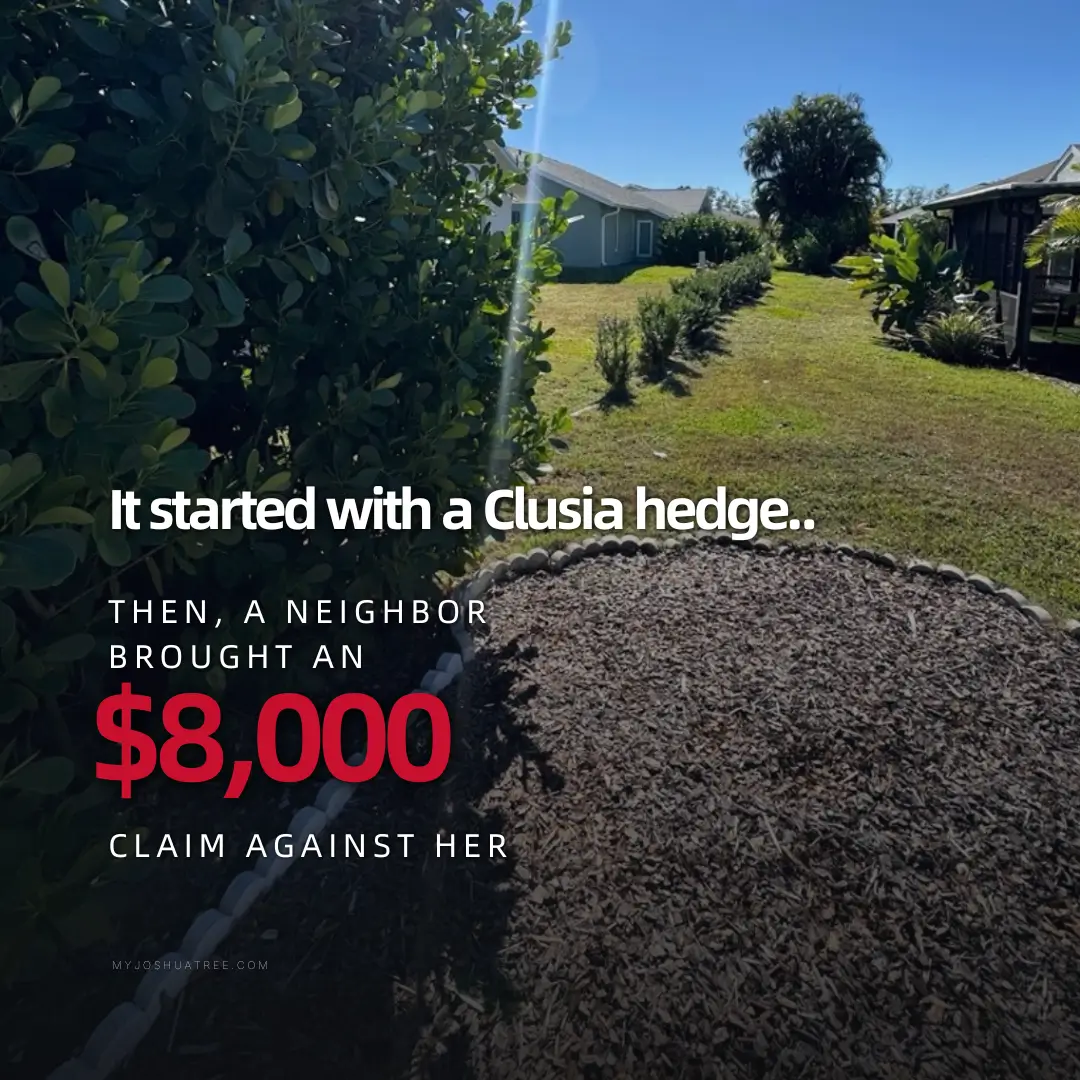
That is a Joshua Tree arborist at the Lee County courthouse in Fort Myers, far from any canopy. He had no stake in the dispute and no role in giving legal advice. He was there because a homeowner in Southwest Florida had pruned a hedge along a property line, the neighbor disagreed with what had been done, and the disagreement had already become a filed claim.
The amount at issue was $8,000.
That number deserves a second look, because it is no coincidence. In Florida, small claims court handles disputes where the amount at issue does not exceed $8,000. The claim was filed at the exact ceiling of what the venue allows. Whatever the merits, the hedge had stopped being a landscaping question and had become the maximum a small claims case can be worth.
In Lee County alone, there were 9,387 small claims filings in fiscal year 2023–24. That is roughly twenty-six a day. Most of the people in that queue arrive without an attorney, because Florida does not require one: as the Lee County Clerk of Court puts it, “You can represent yourself or seek assistance of an attorney.” In the overwhelming majority of these cases, documentation does the work a lawyer otherwise would.
This homeowner decided to get better documentation.
How a Property Line Hedge Became an $8,000 Claim
“What brought me in was that the neighbor said they had gone beyond the property line boundary.”
This is the ordinary shape of an extraordinary number of disputes. A hedge grows. Nobody plants a hedge intending to create a legal question, but hedges do not read plats. Over a few seasons the foliage crosses a line that exists on paper and nowhere in the soil. Someone eventually trims it. And then two neighbors discover they have different beliefs about what was allowed.
“The client found out they were going to small claims court, and they contacted us for a professional ISA Certified Arborist letter.”
That sentence is the reason this story is worth telling: most homeowners do not know that option is available to them. They know you can hire someone to cut a tree. Far fewer know you can hire someone credentialed to evaluate the cut and put their professional findings in writing.
Florida Law on Trimming a Neighbor’s Hedge: Where, Not How Much
Here is the part that surprises people, and it is worth being precise about it.
Florida law on encroaching vegetation is settled and has been for decades. The controlling case is Gallo v. Heller, 512 So. 2d 215 (Fla. 3d DCA 1987), which held that a landowner is not liable to neighbors for a nuisance created by trees and natural vegetation growing on their land, and that:
“The adjoining property owner to such a nuisance, however, is privileged to trim back, at the adjoining owner’s own expense, any encroaching tree roots or branches and other vegetation which has grown onto his property.”
The University of Florida’s Handbook of Florida Fence and Property Law states the rule in plain language, and note the qualifier at the end:
“The adjoining landowner may, at his or her own expense, trim back the branches or roots as he or she desires up to the property line.”
That rule has been reaffirmed since, including in Scott v. McCarty, 41 So. 3d 989 (Fla. 4th DCA 2010).
So the law answers the question of location clearly. You may trim to the line. You may not cross it.
What the rule does not spell out is severity. It gives you the right to trim, but it says nothing about how much of a living plant can come off at one time. The UF handbook itself notes that the limits of self-help beyond simple trimming remain an open question.
This is the space an arborist occupies. The survey establishes where the line is. The standard establishes whether what happened at that line was reasonable. Those are two different questions, answered by two different professions, and the second one goes unanswered until someone qualified is asked.
What an ISA Certified Arborist Assessment Involves
“They presented the survey, which went right up to the property line itself.”
The assessment began with documented boundary evidence rather than assumption. That matters, because an opinion built on a guess about where the line sits is worth precisely nothing.
“As an arborist, I visit the site, I examine the trees or hedges, and I offer a diagnosis through ANSI A300 standards and Best Management Practices.”
That is the job described in one sentence. Three things are worth unpacking in it.
ANSI A300 is the American National Standard for tree care operations, developed by the Accredited Standards Committee A300 and published by the Tree Care Industry Association. It is the written reference professional arborists work from when specifying and evaluating pruning.
Best Management Practices are the companion publications that translate the standard into field application.
Diagnosis is the operative word: a finding, reached by applying a recognized standard to observed conditions.
How Much Can You Prune a Hedge? The 25% Question
“We go by the standards in the Best Management Practices and the ANSI standards: about 25% foliage removal maximum at one time. It never exceeded that. That’s what keeps the hedge healthy.”
The 25% figure is the number most people in the industry reach for, and it is the right starting point. The accurate version of this answer has more in it, and homeowners deserve the accurate version.
For years, the industry leaned on 25% as a fixed ceiling. The 2023 revision of the standard changed the approach. Writing in TCI Magazine, published by the Tree Care Industry Association, one arborist lists among the most significant changes:
“The shift from the rigid ‘25% rule’ to objective-based pruning. Objective-based pruning allows arborists to remove the amount of foliage necessary to achieve the stated objective. Tree species, vigor, health and pruning interval determine the appropriate pruning dose – without creating a technical violation of an arbitrary percentage.”
And the University of Florida is blunter still about why a flat percentage is inadequate:
“ANSI A300 pruning standards allow up to 25% of live foliage removal on mature trees, but this is too much in many circumstances and not enough in others.”
UF goes further, advising that on mature trees “there should be a very good reason, such as to reduce likelihood of branch failure, when removing more than ten percent of the live foliage.”
So what is the takeaway? Treat the 25% figure as a guardrail. It marks the outer edge of defensible practice under general guidance, and staying inside it is meaningful evidence of restraint. The professional question goes one step further: given this species, this specimen’s health and vigor, this maturity, and this objective, was the amount removed appropriate?
That is a judgment. Judgments require credentials. Which is exactly why the answer came from an ISA Certified Arborist and not from either neighbor.
For overgrown shrubs, UF/IFAS offers a separate guideline: rejuvenate them by “removing one-third of the plant each year for three years.” This widely taught one-third rule is a renovation schedule, corroborated across land-grant extension services nationally, rather than a limit on routine trimming. UF/IFAS also notes a detail almost every homeowner gets wrong: a hedge should be trimmed so that “the top is narrower than the bottom,” because box-shaped hedges starve their own lower branches of sunlight until those branches thin out and die.
What the Assessment Found
“The summary of it is: the hedge is very healthy. It’s vibrant.”
The findings, documented in a written ISA Certified Arborist assessment:
| Element evaluated | Finding |
| Overall hedge health and vigor | Healthy and vibrant |
| Pruning technique | Consistent with accepted professional practice |
| Volume of foliage removed | Did not exceed recommended limits under Best Management Practices |
| Recovery response | Consistent with what proper pruning produces |
| Relationship to boundary | Evaluated against the homeowner’s survey |
And then there is the quietest line in the entire recording, which happens to be the most important one:
“I know the diameters, where it’s going to grow, and how fast it grows.”
That sentence marks the dividing line between someone who owns equipment and someone who holds a credential. An arborist assesses the plant’s trajectory as well as what was cut, and that is verifiable, species-level knowledge. UF/IFAS documents, for example, that podocarpus reaches thirty to forty feet when left unsheared and “looks better when pruned with a hand pruner, not sheared with a hedge trimmer”; that inland cocoplum can reach fifteen to twenty-five feet if not pruned smaller; and that pitch apple clusia, one of the most popular screening plants in Florida landscapes, grows twenty-five to thirty feet tall.
Knowing which plant you are standing in front of, how large it wants to become, and how fast it will get there is what allows an arborist to say whether a given cut was reasonable or reckless.
The Outcome
The homeowner used the professional arborist assessment as part of their small claims case. The $8,000 claim was avoided.
Two clarifications, stated plainly because they matter. Joshua Tree did not provide legal representation and did not provide legal advice. And courts decide cases; an arborist’s report does not “win” one. What an objective, standards-based assessment does is replace a disagreement between two neighbors with a documented professional finding.
Why This Keeps Happening in Southwest Florida
Disputes like this one are structural here, and the numbers explain why.
| Factor | Figure | Source |
| Lee County population growth, Apr 2020 to Jul 2025 | +15.1%, to 875,607 | U.S. Census Bureau |
| Cape Coral population growth, same period | +21.8%, to 236,264 | U.S. Census Bureau |
| Collier County population growth, same period | +11.0%, to 417,131 | U.S. Census Bureau |
| Florida homes within an HOA | 45%, highest in the nation | Foundation for Community Association Research data |
| Lee County structures impacted by Hurricane Ian | 52,514 impacted; 5,369 destroyed | National Hurricane Center |
Put those together. Southwest Florida is adding people quickly, onto platted lots where neighbors are close, in the most HOA-dense state in the country, while the region replants a canopy that a Category 4 hurricane rearranged in September 2022. Two years after Ian, UF/IFAS Extension in Lee County was still documenting the aftermath, including a large sabal palm die-off on Sanibel and mangrove stands that had not recovered.
New plantings. Tight lot lines. Fast-growing tropical hedge species. Engaged HOAs. Neighbors who are, in many cases, brand new to each other. Here, property-line vegetation friction is a predictable output of the environment.
More Than a Tree Company
Joshua Tree’s homepage puts it this way: your yard is “where life happens.”
That sounds like brand language until a courthouse is involved. Then it becomes literal. The hedge in this case was a boundary, a privacy screen, a shared responsibility between two households, an asset, and eventually the subject of a filed claim. Trees and hedges sit at the intersection of health, safety, property value, neighbor relationships, insurance, and regulation. The profession that understands them has to advise as well as cut.
That is what an ISA Certified Arborist is trained for. The credential requires a minimum of three years of full-time arboricultural experience or an equivalent combination of education and practice, an examination spanning ten knowledge domains, and adherence to the ISA Code of Ethics. Board Certified Master Arborist is ISA’s highest certification level; candidates have typically held the Certified Arborist credential for three to five years before sitting for a far more extensive exam. Joshua Tree’s team includes Board Certified Master Arborists.
Those credentials are what make a written assessment mean something to somebody other than the person who paid for it.
Frequently Asked Questions
Can I trim my neighbor’s hedge or branches that hang over my property in Florida?
In Florida, generally yes: at your own expense, and only up to the property line.
How much of a hedge can be safely removed at one time?
That depends on species, health, maturity, and objective. This is the question with no fixed answer in the law, and the one worth asking a professional.
Can improper pruning kill a hedge or tree?
Yes. The ISA describes topping as “perhaps the most harmful tree pruning practice known,” noting it often removes 50 to 100 percent of the leaf-bearing crown.
What if my neighbor disagrees with how I trimmed?
Start with documentation. A property survey shows where the line is, and a written assessment from an ISA Certified Arborist shows whether the work met professional standards. That combination is what the homeowner in this case had in hand.
Who owns a tree or hedge that sits on the property line?
A trunk straddling the boundary is generally treated as a jointly owned boundary tree, and neither owner can remove it without the other’s consent.
Every one of those can be answered before money is at stake.
Before It Becomes a Filing
If there is vegetation on or near your property line and you are unsure what you are allowed to do, the least expensive moment to ask is right now: before the shears come out, and long before anyone drives to Fort Myers.
Joshua Tree’s ISA Certified Arborists provide professional assessments of trees and hedges throughout Cape Coral, Fort Myers, Naples, Bonita Springs, Estero, and across Southwest Florida, evaluated against ANSI A300 standards and Best Management Practices. Our role is to tell you, without taking a side, what is actually there, what condition it is in, and what proper care of it looks like, in writing if you need it in writing.
Call (239) 888-6817 Request a Free Estimate
Case Study Disclaimer
This article is provided as a real-world case study and is not legal advice. Joshua Tree Inc.’s role in this matter was limited to providing an independent professional arborist assessment performed by an ISA Certified Arborist applying ANSI A300 standards and Best Management Practices. The homeowner used that assessment as part of their case; Joshua Tree Inc. did not provide legal representation. Details have been generalized to protect the privacy of the parties involved. Because every property, plant species, ordinance, and legal matter is different, homeowners should obtain professional and legal guidance specific to their own circumstances.
Related Reading
- How Often Should I Have My Trees Pruned?
- What Happens When Protected Mangroves Are Removed Without a Permit in Florida?
Sources & Further Reading
Joshua Tree services
External
- Small Claims, Lee County Clerk of Court.
- Florida’s Trial Court Statistical Reference Guide FY 2023-24, Chapter 8: County Civil, Florida Office of the State Courts Administrator.
- Gallo v. Heller, 512 So. 2d 215, 216 (Fla. 3d DCA 1987), as quoted in source 4.
- Olexa, M.T., Van Treese II, J.W., & Hill, C.A. Handbook of Florida Fence and Property Law: Trees and Landowner Responsibility, UF/IFAS Extension FE962.
- Stop Pruning Malpractice with a Prescription, TCI Magazine, Tree Care Industry Association.
- Mature trees: managing risk, UF/IFAS Landscape Plants.
- Pruning Shrubs and Hedges, UF/IFAS Gardening Solutions.
- Podocarpus macrophyllus, UF/IFAS EDIS ST495.
- Cocoplum, UF/IFAS Gardening Solutions.
- Clusia rosea: Pitch Apple, UF/IFAS EDIS ST172.
- U.S. Census Bureau QuickFacts: Lee County, Cape Coral city, and Collier County, Florida.
- 45% of Florida homes are part of an HOA, the highest percentage in the nation, South Florida Agent Magazine, April 20, 2023 (analysis of Foundation for Community Association Research data).
- National Hurricane Center, Tropical Cyclone Report: Hurricane Ian (AL092022).
- Ongoing Impacts on Urban Forests Two Years After Hurricane Ian, UF/IFAS Extension Lee County, October 7, 2024.
- Why Topping Hurts Trees, International Society of Arboriculture brochure.
- Know Your Rights and Responsibilities: Trees on Property Lines, UF/IFAS Extension Hillsborough County, July 9, 2024.
- ISA Certified Arborist Application Guide, International Society of Arboriculture.